Notice earlier.
Decide with evidence.
Prove you were watching.
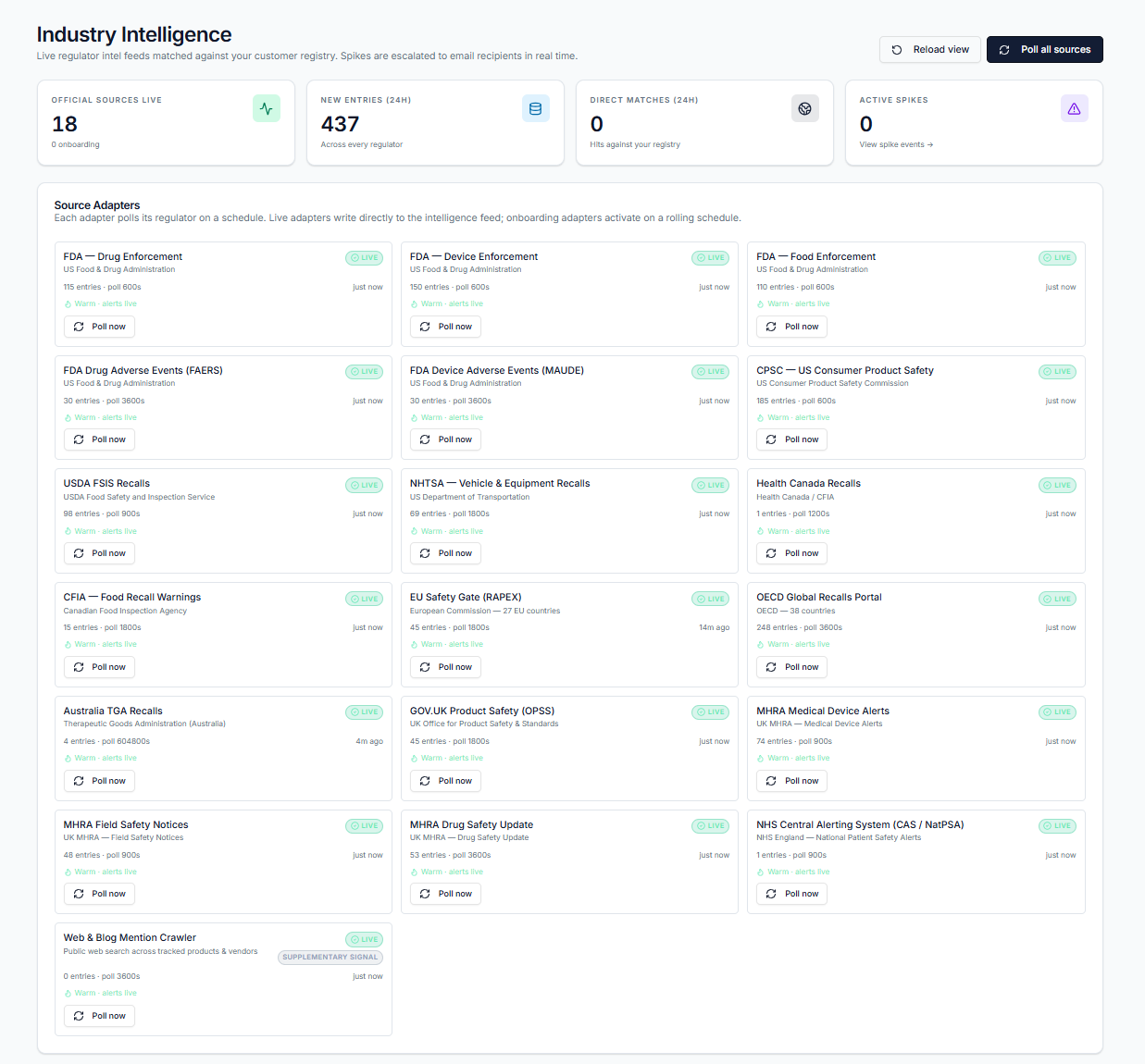
SuperRecall.ai monitors 18 official regulatory APIs across 60+ countries — surfacing recall risk signals for your quality team to adjudicate. The noticing is automated. The judgment stays with your people.
Screens shown with illustrative data
Built for Regulated Industries
Purpose-built compliance workflows for the industries where recalls matter most
Covering FDA, CPSC, MHRA, EU Safety Gate, Health Canada, CFIA, TGA and 11 more official regulatory APIs across these sectors
Four modules. One compliance posture.
Plans combine modules. Add only what your programme requires.
Continuous regulatory scanning
18 official regulatory APIs, 60+ countries, polled continuously — FDA, CPSC, NHTSA, MHRA, EU Safety Gate, Health Canada, CFIA, TGA and more.
Product-to-signal matching
Signals cross-referenced against your product registry and supplier network — clusters and rate inflections flagged for your team.
Filing preparation
Filing Preparation assembles the regulatory package — your qualified professional reviews, decides, and files.
Audit-ready documentation
A timestamped, attributable, tamper-evident documentation trail — built automatically, retrievable in any inspection.
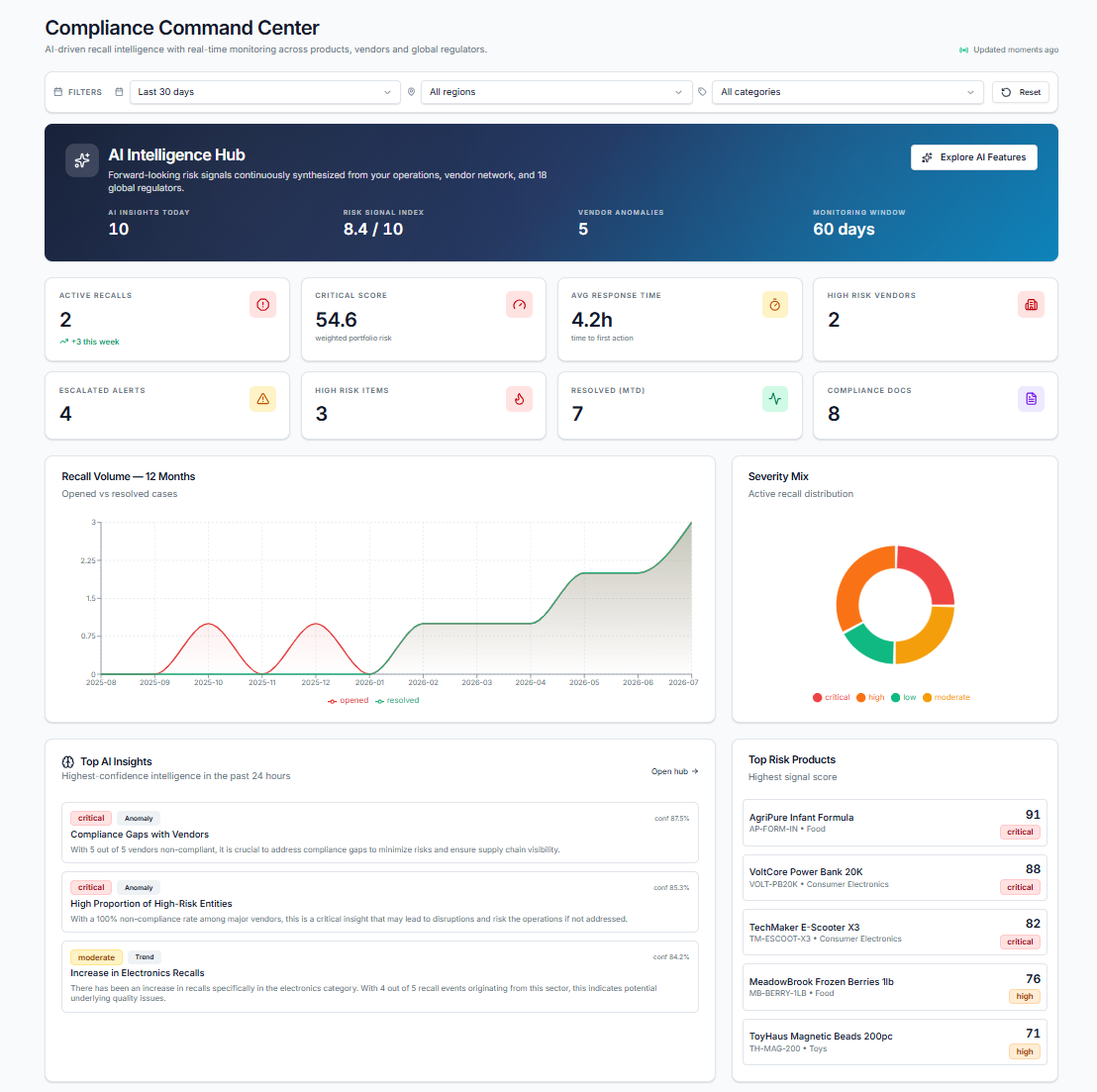
Your entire recall surface.
One screen.
- Every jurisdiction you monitor, visible in a single dashboard
- Signals matched to your products and suppliers — irrelevant noise filtered out
- Adjudication decisions logged in-workflow with reviewer identity and timestamp
Screens shown with illustrative data
Screens shown with illustrative data
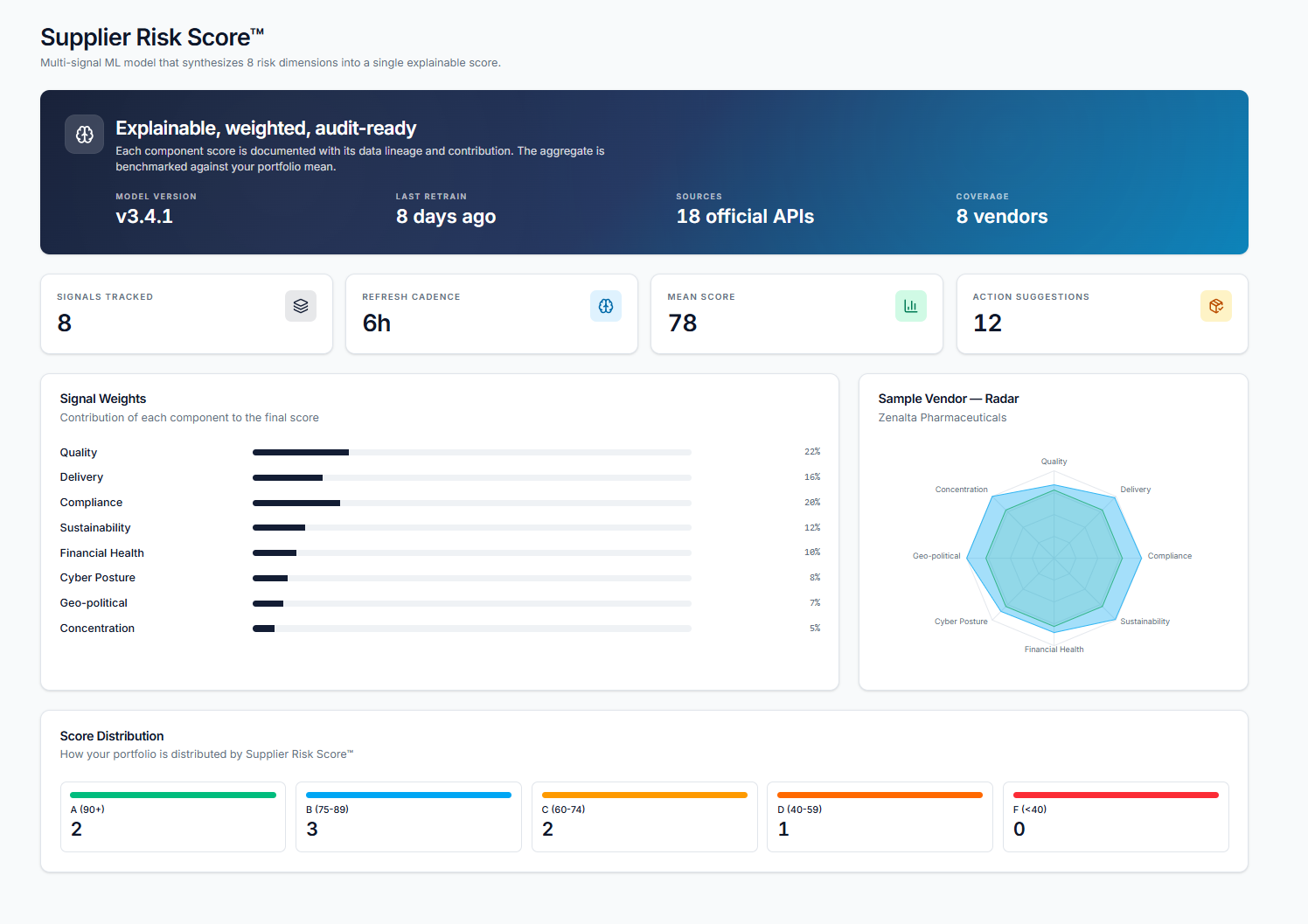
Explainable. Weighted.
Audit-ready.
Supplier Risk Scores show your quality team exactly which signals contributed to the score, at what weight, and when they were last reviewed.
No black-box outputs. Every score can be explained, documented, and defended.
The cost difference is the business case.
$400K ingredient-level withdrawal vs. a multi-brand cascade in the millions
Read the analysis$280K quality overhaul vs. $3.2M Class II recall exposure
Read the analysis18,000-unit targeted lot recall vs. 140,000-unit full-SKU action
Read the analysisCase studies are composites drawn from publicly documented recall patterns. They do not depict any specific company, product, or event. Figures are illustrative.
Founding Customer Program — a limited number of early customers receive a locked founder rate in exchange for structured feedback and a reference.
Talk to the founderSuperRecall.ai assists with monitoring, drafting, impact assessment, and documentation. Final regulatory decisions and submissions remain under your authorised quality, regulatory, or compliance team.
Modular pricing. No wasted seats.
Start with the modules your programme needs. Add as your compliance footprint grows. All plans include guided onboarding and a 30-day satisfaction guarantee.
- 1 product domain
- 1 regulatory region
- 3 user accounts
- 18 official regulatory API coverage
- Product-to-signal matching against your catalogue
- Email alerts on matched signals
- Guided onboarding
- Standard support (2-business-day response)
PREPARE and PROVE available as add-ons
- Up to 3 product domains
- Multi-region coverage
- 10 user accounts
- All Essential features
- Filing Preparation (FDA, CPSC, EU Safety Gate, Health Canada)
- Slack & Teams alert routing
- Priority support (next business day)
- Dedicated onboarding specialist
PROVE and Integrations & API available as add-ons
- All 18 official regulatory APIs — 60+ countries
- Unlimited product domains
- Unlimited user accounts
- All Professional features
- Documentation & Audit Trail (PROVE module)
- Integrations & API included
- SSO, MFA, RBAC, data residency options on request
- Dedicated account manager · 24/7 support
- Custom SLA options
Adjudication Support available — custom pricing
Annual billing and custom packages available — speak to our team.
Module coverage by plan
| Module | Essential | Professional | Enterprise |
|---|---|---|---|
| MONITORContinuous scanning of 18 official regulatory APIs | |||
| MATCHSignal matched against your product catalogue and supplier list | |||
| PREPAREDraft regulatory filings structured for submission review | Add-on | ||
| PROVEFull adjudication log, decision trail, and tamper-proof audit record | Add-on | Add-on |
Add-on modules
Available on any plan. Managed through your account.
Draft regulatory filings structured for FDA, CPSC, EU Safety Gate, or Health Canada review. Available as an add-on to Essential.
Full adjudication log with reviewer identity, timestamps, and decision rationale. Available as an add-on to Essential or Professional.
Full REST API access, webhooks, and pre-built connectors for Slack, Teams, and common QMS platforms.
A dedicated compliance analyst reviews flagged signals alongside your team and documents the adjudication outcome. Pricing on request.
Common questions about pricing
Does SuperRecall.ai predict or prevent recalls?
No. The platform surfaces and aggregates signals from official regulatory sources and flags emerging patterns. A qualified professional on your team adjudicates every signal and makes every decision. The noticing is automated; the judgment is human.
What counts as a product domain or region?
A product domain is a distinct product category or brand that you configure for monitoring — for example, "ready-to-eat meals" or "home medical devices" would each count as one domain. A region is a regulatory jurisdiction: US, EU, Canada, and UK are each separate regions. The Essential plan covers one of each. Professional covers up to three domains across multiple regions simultaneously.
How does Filing Preparation work?
When a matched signal requires a regulatory response, the PREPARE module assembles the relevant regulatory package — structured for FDA, CPSC, EU Safety Gate, or Health Canada format. Your qualified professional reviews every draft, makes the decision, and submits. The platform prepares; your team decides and files. Filing Preparation is included in Professional and Enterprise, and available as a $299/month add-on on Essential.
What are the contract terms? Can I cancel?
Essential is month-to-month — cancel anytime with no penalty. Professional and Enterprise are available on monthly or annual terms; annual billing is discounted approximately 17%. On cancellation, you have 90 days to export your product catalogue, recall history, and audit logs before data deletion.
How is my data secured?
All data is encrypted with AES-256 at rest and TLS 1.3 in transit. We maintain role-based access control (RBAC), SSO with MFA enforcement, and a tamper-proof audit log. SuperRecall.ai is ISO/IEC 27001 certified, independently audited by Intertek. SOC 2 Type II attestation is in progress. Full details are on our Security page.
All plans include AES-256 encryption at rest, TLS 1.3 in transit, role-based access control, and tamper-proof audit logging. ISO/IEC 27001 certified, independently audited by Intertek. SOC 2 Type II in progress. Security details →
Founding Customer Program — a limited number of early customers receive a locked founder rate in exchange for structured feedback and a reference.
Talk to the founderFrequently Asked Questions
Everything you need to know about SuperRecall.ai
Still have questions?
Our team is here to help you understand how SuperRecall.ai can support your recall management programme.
See What Regulators Know About Your Suppliers
Enter your work email and company — we'll send you a free recall exposure report within 48 hours
ISO/IEC 27001 Certified · Audited by Intertek