CPSC Section 15(b) Reporting, Lithium-Ion Battery Recall Management, and EU Safety Gate Obligations for Electronics OEMs

    A practical compliance guide for consumer electronics manufacturers and appliance OEMs navigating CPSC reporting deadlines, battery recall complexity, and EU Safety Gate RAPEX notification requirements in 2026

    13 min read

    CPSC Section 15(b) Reporting, Lithium-Ion Battery Recall Management, and EU Safety Gate Obligations for Electronics OEMs

    A practical compliance guide for consumer electronics manufacturers and appliance OEMs navigating CPSC reporting deadlines, battery recall complexity, and EU Safety Gate RAPEX notification requirements in 2026.

    Why Electronics Recalls Are a Different Category of Complexity

    No other product category generates safety recalls with the same combination of scale, velocity, and regulatory multi-jurisdiction complexity as consumer electronics and household appliances. A lithium-ion battery defect in a line of portable power stations can affect 800,000 units sold across 44 countries, sourced from cell manufacturers in South Korea, assembled in Vietnam, branded under a U.S. OEM's label, and distributed through Amazon, Best Buy, Home Depot, Walmart, and 23 additional retail channels — all within a product lifecycle of 18 months.

    The regulatory consequences of that defect unfold simultaneously across multiple systems: the CPSC expects a Section 15(b) report within 24 hours of a reportable determination; the EU Safety Gate publishes a RAPEX notification that triggers removal actions across all 30 member states within 48 hours; Transport Canada issues a mandatory recall notice; Amazon initiates a stop-sale on all affected ASINs; and the manufacturer's warranty and reverse logistics systems are overwhelmed by consumer remedy requests before a public communication plan has been finalized.

    Most consumer electronics OEMs and appliance manufacturers have the product safety infrastructure to handle a quiet, single-market, single-channel recall. Very few have the systems to execute the kind of coordinated, multi-jurisdiction, multi-channel recall that a serious battery incident requires. This guide is intended to help close that gap.

    CPSC Section 15(b): What Triggers the Reporting Obligation

    The Consumer Product Safety Act (CPSA) Section 15(b) imposes one of the most consequential reporting obligations in U.S. product liability law. Any manufacturer, importer, distributor, or retailer of a consumer product must immediately report to the CPSC when it obtains information that reasonably supports the conclusion that:

    • The product contains a defect that could create a substantial product hazard
    • The product creates an unreasonable risk of serious injury or death
    • The product fails to comply with a consumer product safety rule, regulation, standard, or ban

    The word "immediately" is defined by CPSC regulation as within 24 hours of the time the company obtains information that reasonably supports one of these conclusions. This is not a soft deadline — CPSC enforcement actions and civil penalty assessments consistently cite delays of days or weeks between when a company's internal data supported a reportable conclusion and when the Section 15(b) report was actually filed.

    What "Reasonably Supports" Means in Practice

    CPSC's interpretation of "reasonably supports" is broader than most compliance teams expect. The agency does not require that a company has concluded a defect exists before the reporting obligation is triggered — the obligation attaches when the weight of available information could reasonably support that conclusion, even while the company continues to investigate.

    For consumer electronics and appliance OEMs, this standard is most frequently triggered by:

    Battery thermal events: A single confirmed fire attributed to a battery thermal runaway event — documented in warranty records, consumer complaints, or field reports — can trigger Section 15(b) reporting obligations even if the root cause investigation is ongoing. CPSC's enforcement history shows that companies that waited for root cause confirmation before filing often faced civil penalties measured in millions of dollars.

    Clustering of injury reports: An unusual cluster of burns, shocks, or laceration injuries in consumer complaints or warranty claims related to the same product or component system creates Section 15(b) reporting exposure. The clustering threshold is not defined by statute — it is evaluated based on the severity of harm, the number of incidents, and the product's population.

    Field technical service bulletins: When a manufacturer issues a technical service bulletin directing field technicians or retailers to replace a specific component due to a safety-related defect, that action can itself constitute a "reportable information" trigger under Section 15(b), even if no formal recall decision has been made.

    Supplier notifications: When a component supplier notifies an OEM that a production lot of batteries, capacitors, or power electronics may have a manufacturing deviation, that notification is "information obtained" — and the 24-hour clock begins running from the moment the OEM's quality or safety team receives it.

    The 24-Hour Reporting Window: Operational Requirements

    Complying with a 24-hour reporting window requires infrastructure that most consumer electronics companies have not built. The typical organizational failure mode looks like this: a product safety incident is reported to customer service; customer service routes it to the warranty team; the warranty team logs it as a claim but does not escalate to the regulatory affairs team; three weeks later, a second incident surfaces; the regulatory affairs team is notified; and the Section 15(b) report is filed 22 days after the first reportable event.

    This sequence — documented repeatedly in CPSC enforcement actions — generates civil penalty exposure under 15 U.S.C. § 2069, which allows penalties of up to $15 million per violation series.

    What functional Section 15(b) readiness requires:

    • A centralized incident intake system that routes all safety-related consumer complaints, warranty claims, field reports, and supplier notifications to the regulatory affairs team in real time — not through weekly review cycles
    • Defined internal escalation criteria that allow the regulatory team to assess Section 15(b) exposure immediately upon receipt of safety incident data, without waiting for engineering root cause completion
    • Pre-drafted Section 15(b) report templates covering the most likely incident types (battery thermal event, electric shock, fire, laceration) that allow rapid filing once the reporting threshold is met
    • A documented legal hold and evidence preservation protocol that activates automatically when a reportable event is identified

    The CPSC Fast Track Program: What It Is and When to Use It

    The CPSC Fast Track Product Recall Program is a voluntary mechanism that allows companies to initiate a recall within 20 calendar days of receiving CPSC's written acknowledgment of their Section 15(b) report — without undergoing the full hazard assessment and negotiation process that standard recalls require.

    In exchange for the accelerated timeline, companies waive their right to contest the hazard finding. The Fast Track program does not require CPSC to find that a substantial product hazard exists — participation is available whenever a company chooses to initiate a voluntary corrective action in response to a Section 15(b) report.

    When Fast Track Makes Sense for Electronics OEMs

    For battery-related incidents — particularly lithium-ion battery fires — Fast Track participation is almost always the right strategic choice. The reasons are straightforward:

    Speed reduces exposure: Every day a potentially defective product remains in commerce after a reportable incident increases the legal and regulatory exposure. Fast Track compresses the recall timeline from the typical 60–120 days of CPSC negotiation to as few as 20 days.

    Regulatory goodwill: CPSC staff evaluations of civil penalty cases consistently note whether a company cooperated promptly and initiated Fast Track, or whether it contested and delayed. The difference in penalty outcomes is material.

    Consumer expectations: Battery fire incidents generate media coverage that a slow, contested recall process amplifies. A Fast Track recall that is announced promptly, with clear remedy instructions and a consumer-friendly remedy portal, typically generates less negative media amplification than a recall that emerges from months of regulatory back-and-forth.

    The Fast Track limitation: Fast Track requires that the company have an approved remedy ready to offer consumers — typically a refund, replacement, or retrofit — and the logistics infrastructure to execute that remedy at scale. Companies that lack lot-level inventory tracking or reverse logistics capabilities for high-volume consumer products often cannot operationalize a Fast Track recall within the 20-day window, even when the strategic case for participation is clear.

    Lithium-Ion Battery Recall Management: The Multi-Tier Supply Chain Problem

    Lithium-ion battery recalls are structurally more complex than almost any other category of consumer product recall, for a reason that is rooted in the supply chain rather than the regulatory framework: the chain of responsibility for a battery defect runs through at least three and often five or more distinct tiers.

    A typical consumer electronics battery supply chain looks like this:

    1. Cell manufacturer (often South Korean, Chinese, or Japanese) produces the individual battery cells — cylindrical, prismatic, or pouch format — from raw materials including lithium, cobalt, and graphite
    2. Battery pack assembler combines individual cells into a battery module or pack, adds the battery management system (BMS), and specifies thermal management and protection circuits
    3. Device OEM integrates the battery pack into the finished product — a laptop, power tool, e-scooter, or household appliance — and specifies the charging circuitry and thermal protection parameters
    4. Contract manufacturer or EMS provider (in many cases) assembles the final product and may source battery packs independently under specifications provided by the OEM
    5. Importer and/or brand owner is the entity legally responsible under CPSA for the product's safety compliance, regardless of where in the supply chain the defect originated

    When a battery fire incident occurs, the Section 15(b) reporting obligation falls on the brand owner or importer — not on the cell manufacturer or pack assembler, even if the defect originated at their level. This creates a recall management challenge: the brand owner must define recall scope, communicate with CPSC, and execute consumer remedy, while simultaneously pursuing root cause investigation across supply chain tiers that may be located in multiple countries and may have limited incentives for rapid cooperation.

    Lot-Level Traceability: The Foundation of Scope Definition

    The single most consequential gap in most consumer electronics recall programs is the absence of lot-level battery traceability. Without the ability to trace which production lots of battery cells or packs were incorporated into which device serial numbers or date codes, a brand cannot define a precise recall scope — it can only define a broad, conservative scope that captures the entire affected model line.

    The difference between a targeted recall of 45,000 units (the specific date-code range incorporating a defective cell lot) and a conservative recall of 800,000 units (the entire model line for that calendar year) is measured in tens of millions of dollars of remedy cost, retailer compensation, and return logistics expense. It is also measured in consumer disruption and brand reputation impact — a recall of 800,000 units that affects 755,000 non-defective products generates disproportionate consumer anger relative to a recall of 45,000 units that precisely targets the affected population.

    What lot-level battery traceability requires:

    • A supplier data specification that requires battery cell and pack manufacturers to provide lot-level production data — including date of manufacture, production line identifier, and cell chemistry batch identifier — in a machine-readable format at time of delivery
    • An inventory management system that associates incoming battery lot data with the device serial numbers produced during each manufacturing run
    • A field data system that links warranty registrations, returns, and repair records to device serial numbers — enabling rapid identification of how many potentially affected units remain in consumer hands versus how many have already been returned, replaced, or scrapped
    • A regulatory filing capability that can generate a precise affected-population estimate for CPSC Part 1115 reporting based on lot-level data rather than conservative model-year estimates

    EU Safety Gate: How RAPEX Works and What It Means for Electronics OEMs

    The EU Safety Gate — formerly known as RAPEX (Rapid Alert System for dangerous non-food products) — is the European Commission's mechanism for coordinating rapid response to consumer products that pose a serious risk to health and safety. For consumer electronics and appliance manufacturers selling in European markets, the EU Safety Gate is the most significant post-market surveillance mechanism outside of CPSC.

    How a RAPEX Alert Is Generated

    A RAPEX alert follows a structured process:

    1. Market surveillance authority (MSA) identification: A national market surveillance authority in one of the EU member states — the Bundesnetzagentur in Germany, the OPSS in the United Kingdom (pre-Brexit), the DGSIE in France, or any of the other 27 national bodies — identifies a product that poses a serious risk, typically through market monitoring, consumer complaints, or coordination with customs authorities
    2. National notification to the Commission: The MSA notifies the European Commission's Safety Gate database, providing the product description, the identified hazard, the corrective action taken (market withdrawal, recall, ban on export), and the risk assessment supporting the classification as a serious risk
    3. Commission publication: The Commission publishes the alert on the Safety Gate portal, typically within one to two business days of receiving the national notification, making the alert publicly visible to all member states, consumers, and media
    4. Member state response: Other member states review the alert and take appropriate action in their own markets — ranging from requesting additional market surveillance to issuing their own recall or withdrawal orders

    The publication of a Safety Gate alert is a public event. Unlike a CPSC Section 15(b) report, which is filed confidentially and may remain non-public during CPSC's hazard assessment process, a Safety Gate alert is immediately visible to consumers, journalists, retailer buyers, and plaintiff attorneys in every EU member state simultaneously.

    The 48-Hour Reality

    From the moment a Safety Gate alert is published, the practical window for an electronics OEM to get ahead of the narrative is approximately 48 hours. In that window:

    • Major EU retailers receive automated Safety Gate alert feeds and begin their own market withdrawal processes
    • Consumer protection journalists in major EU markets (Germany, France, Italy, Netherlands) begin reporting on the alert
    • Amazon EU marketplace systems flag the ASIN for removal, sometimes before the OEM has been directly notified
    • National consumer associations begin aggregating Safety Gate alerts for their monthly bulletins

    For electronics OEMs that do not actively monitor the Safety Gate feed against their product portfolio, the first indication that an alert has been published is often a retailer phone call, a media inquiry, or — in the worst case — a declining sales velocity pattern that prompts an internal investigation weeks after the fact.

    Proactive Safety Gate Monitoring

    Effective EU Safety Gate compliance for electronics OEMs requires automated monitoring of the Safety Gate alert feed against the company's full product portfolio — including products sold under private label arrangements, products sold by authorized distributors, and products that may be affected by component-level alerts (battery alerts that apply to the same cell chemistry used in multiple product lines).

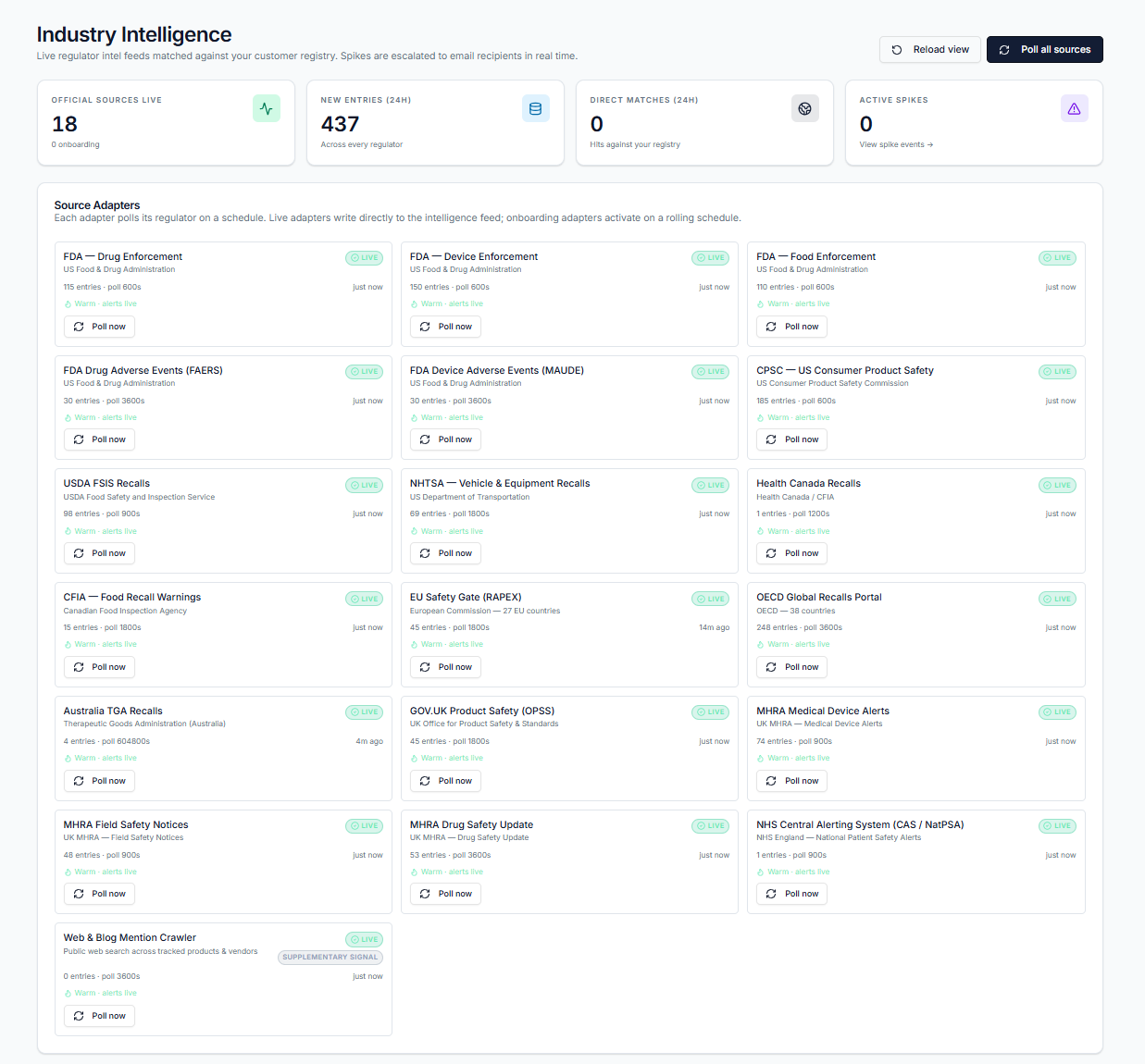
    The Safety Gate feed is publicly accessible via the European Commission's API and includes product descriptions, model numbers, barcodes, and manufacturer identifiers in a structured format that supports automated matching. Companies that implement automated matching against their SKU and component databases can identify alerts affecting their portfolio — or their competitors' portfolios — within minutes of publication, rather than hours or days.

    EU Safety Gate Notification Obligations: When the OEM Must Notify

    The EU Safety Gate monitoring function addresses the inbound intelligence problem — knowing when a safety alert has been published about a product in your portfolio. But electronics OEMs operating in the EU also face outbound notification obligations: when should an OEM proactively notify a national MSA that its product poses a serious risk?

    The EU General Product Safety Regulation (GPSR), which replaced the General Product Safety Directive in December 2024, imposes a proactive notification obligation on manufacturers, importers, and distributors: when they become aware that a product they have placed on the EU market poses a serious risk, they must notify the relevant national MSA without delay.

    What triggers the proactive notification obligation:

    • A CPSC recall in the United States covering a product that is also marketed in the EU — the U.S. recall action is typically treated as evidence that the product poses a serious risk in the EU as well, triggering the GPSR notification obligation independently of any EU MSA investigation
    • Field data (injury reports, consumer complaints, warranty claims) meeting the "serious risk" threshold under GPSR, regardless of whether a U.S. recall has been initiated
    • Supplier notifications of component defects that create a serious risk in the finished product — the notification obligation falls on the brand owner regardless of where in the supply chain the defect originated

    The coordination challenge for electronics OEMs is significant: a CPSC Fast Track recall initiated in the United States triggers near-simultaneous GPSR notification obligations across EU member states, Transport Canada notification obligations under the Canada Consumer Product Safety Act, and parallel coordination obligations with Australian Competition and Consumer Commission (ACCC) and other international market surveillance bodies. These obligations do not queue sequentially — they arrive simultaneously.

    Building a Recall-Ready Electronics Compliance Program

    Consumer electronics OEMs and appliance manufacturers that navigate battery incidents and CPSC investigations successfully share a set of operational capabilities that distinguish them from companies that struggle. These capabilities are not primarily technological — they are organizational and process-driven, supported by technology where technology adds speed and scale.

    Incident Detection and Centralization

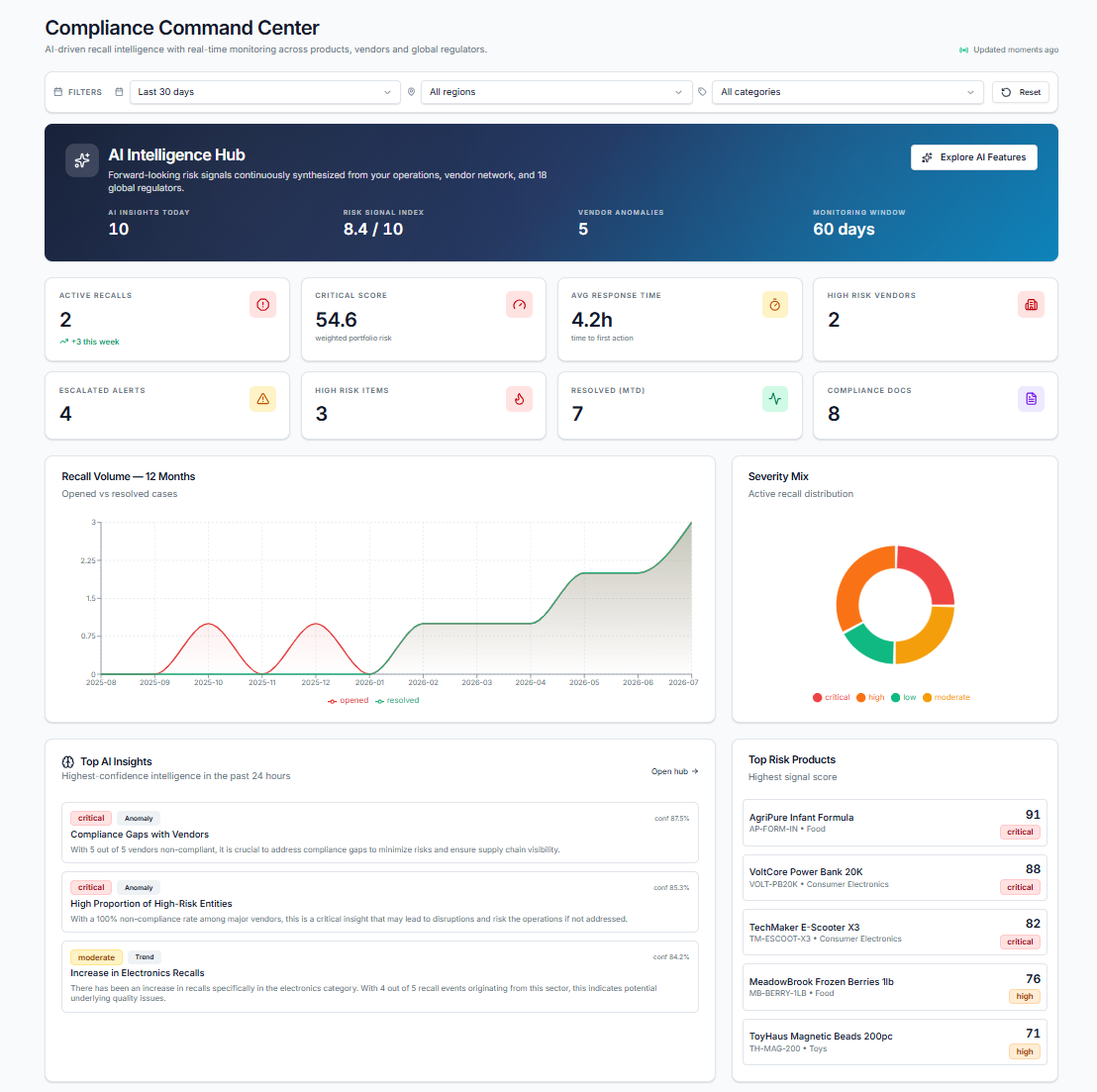
    The most common failure in electronics recall management is not a gap in regulatory knowledge — it is a gap in incident signal aggregation. Safety-relevant signals arrive through multiple channels simultaneously: Amazon review monitoring, warranty claim systems, direct consumer complaint inboxes, social media monitoring, retailer return data, and field service reports. When these signals are reviewed in siloed functions on different timescales, the regulatory team sees a fragmented picture and makes Section 15(b) determinations too late.

    Effective detection requires:

    • A single intake workflow — or an automated aggregation layer — that routes all safety-relevant signals to the product safety team on a real-time or near-real-time basis
    • Defined signal types that automatically escalate to the regulatory team: any battery thermal event report, any injury claim, any fire-related return, any supplier deviation notification
    • An automated trigger system that counts incident clusters — when three reports of the same symptom arrive within a 30-day window for the same model, the regulatory team is notified automatically, not at the next weekly review meeting

    Regulatory Filing Infrastructure

    When a Section 15(b) report must be filed within 24 hours, the company needs pre-built filing templates and a regulatory contact at CPSC who can receive the initial report. Companies that experience their first CPSC interaction as a reactive response to a CPSC inquiry — rather than a proactive Section 15(b) report — start from a significantly worse position.

    Pre-built infrastructure for CPSC reporting:

    • Template Section 15(b) report forms covering the most likely electronics incident types, with guidance notes indicating which fields can be completed with preliminary information and which require confirmed data
    • Legal hold and document preservation protocols that activate automatically upon Section 15(b) determination — preserving warranty records, complaint logs, and supplier communications as a litigation-ready evidence package
    • Pre-established CPSC staff contact for the company's product categories — product safety staff members who know the company, its product lines, and its compliance history before an incident occurs

    Remedy Logistics Readiness

    A recall without a ready remedy is a regulatory and reputational problem of the first order. For electronics OEMs, remedy readiness requires:

    • Refund processing infrastructure: A consumer portal that can accept proof of purchase or serial number, verify eligibility against the affected population, and process a refund within a defined business day window — without requiring consumers to physically return a potentially hazardous product to a retail location
    • Replacement program logistics: If the remedy is a replacement unit, the OEM needs a reverse logistics network capable of collecting affected units (or directing consumers to retain and destroy them, where transport regulations prohibit shipping lithium batteries that have experienced thermal events), processing replacement orders, and tracking completion rates by serial number
    • Retailer coordination workflows: Pre-established stop-sale communication templates for major retail accounts — Amazon Vendor Central, Best Buy, Walmart, Home Depot, Target — that can be executed simultaneously the moment a recall decision is made

    SuperRecall.ai is purpose-built for consumer electronics OEMs and appliance manufacturers managing CPSC Section 15(b) reporting obligations, lithium-ion battery recall traceability, EU Safety Gate RAPEX monitoring, and multi-channel retailer stop-sale coordination. To see how our platform supports your electronics recall compliance program, explore the Electronics & Appliances solution page or request a demonstration.

    Share this article
    Take Action Now

    Ready to Protect Your Brand?

    SuperRecall.ai helps global brands stay ahead of product recalls with AI-powered monitoring and workflow automation. Monitor 44+ regulatory databases including FDA, CPSC, EU Safety Gate, and CFIA — automatically, around the clock.

    We use cookies to improve your experience

    Strictly necessary cookies keep the site running. With your consent we also use Google Analytics 4 to understand how visitors use SuperRecall.ai. You can change your choice at any time. See our Cookie Policy for details.