NHTSA Automotive Recall Management: TREAD Act EWR, ODI Investigations, and VIN-Level Traceability in 2026
How automotive OEMs and Tier 1 suppliers can meet NHTSA ODI monitoring obligations, automate TREAD Act Early Warning Reporting, and execute VIN-level recall scope definition before regulators come calling
NHTSA Automotive Recall Management: TREAD Act EWR, ODI Investigations, and VIN-Level Traceability in 2026
How automotive OEMs and Tier 1 suppliers can meet NHTSA ODI monitoring obligations, automate TREAD Act Early Warning Reporting, and define VIN-level recall scope before regulators escalate.
Why Automotive Recalls Are Different
Automotive recalls operate at a scale and regulatory complexity that has no equivalent in consumer product or pharmaceutical recall management. A single defect in a seat belt pretensioner mechanism can affect 2.3 million vehicles across eleven model years, produced in four assembly plants, incorporating components from six Tier 1 and Tier 2 suppliers, sold in the United States, Canada, Mexico, Germany, Japan, Australia, and a dozen other markets — each with its own regulatory notification deadline, its own owner notification requirement, and its own remedy documentation standard.
The NHTSA regulatory framework that governs this complexity was substantially reshaped by the Transportation Recall Enhancement, Accountability, and Documentation (TREAD) Act of 2000. Enacted in the aftermath of the Ford Explorer/Firestone tire recall — which killed 271 people and resulted in the largest automotive recall at that time — the TREAD Act established the Early Warning Reporting (EWR) system and granted NHTSA new investigative authority that the agency has progressively expanded in the decades since.
Understanding the mechanics of NHTSA's oversight system — how ODI receives data, how it escalates investigations, and what it expects from manufacturers — is the foundation of a functional automotive recall management program in 2026.
The TREAD Act Early Warning Reporting Framework
The TREAD Act requires manufacturers of motor vehicles and motor vehicle equipment to submit quarterly Early Warning Reports to NHTSA covering data that may indicate a safety defect trend. The EWR submission framework covers:
Data categories required in quarterly EWR submissions:
- Deaths and injuries associated with alleged defects or noncompliances (aggregated by make, model, model year, and component system)
- Property damage claims alleging defects (same segmentation)
- Consumer complaints to the manufacturer alleging defects
- Warranty claims and field adjustments segmented by make, model, model year, and component system
- Field technical service bulletins (TSBs) issued during the quarter
- Reports, claims, and notices from foreign regulatory authorities or foreign litigation involving safety issues
Threshold thresholds that trigger reporting: NHTSA's EWR rules establish reporting thresholds for deaths, injuries, and claims by vehicle population size. Manufacturers producing more than 500 vehicles per year must report all death and injury claims regardless of threshold. The quarterly nature of EWR creates a systemic risk: a defect pattern that emerges in January may not reach NHTSA until the end of Q1, even if internal data already shows a clustering.
The real danger: NHTSA's Office of Defects Investigation doesn't just wait for EWR submissions. ODI's own analysts actively monitor the NHTSA complaints database (complaints.nhtsa.dot.gov), which receives consumer submissions directly. When ODI analysts observe a clustering of consumer complaints in the same component system across multiple model years — even before a manufacturer's quarterly EWR arrives — they can open a preliminary evaluation (PE) without warning. The first communication a manufacturer receives may be a PE opening letter, which immediately accelerates the regulatory timeline.
How ODI Investigations Escalate
Understanding ODI's escalation ladder is essential for automotive safety teams. Each stage has distinct obligations and distinct consequences for non-compliance.
Stage 1: Preliminary Evaluation (PE)
A Preliminary Evaluation is ODI's lowest-level investigative action. ODI opens a PE when it identifies a potential defect pattern worth investigating — typically triggered by clustering in consumer complaints, EWR data, or third-party media reports. During a PE, ODI:
- Sends an information request letter to the manufacturer with a 30-day response deadline
- Requests production figures, warranty data, consumer complaints, and field reports related to the subject component
- May conduct owner interviews or field inspections
Manufacturer obligation: Respond completely and accurately within the deadline. Incomplete responses extend the PE and increase ODI's suspicion. Companies that produce strong PE responses — with organized warranty data, clearly articulated defect investigation scope, and a coherent population analysis — have better outcomes than those that produce minimal responses.
Stage 2: Engineering Analysis (EA)
If a PE concludes that further investigation is warranted, ODI opens an Engineering Analysis. An EA is a more formal investigative proceeding:
- ODI issues a more comprehensive information request, typically including requests for testing data, CAD drawings, failure analysis reports, and supplier communications
- NHTSA may conduct its own independent testing of subject vehicles or components
- ODI publishes the EA opening on its website, increasing public and media visibility
- NHTSA often subpoenas documents if the manufacturer's voluntary production is deemed inadequate
What EA means for manufacturers: An open Engineering Analysis creates significant legal and reputational exposure. Media coverage of EA openings routinely triggers additional consumer complaints (the "media amplification" effect documented in NHTSA's own research). Insurance carriers begin tracking the investigation. If the EA ultimately results in a recall, the speed and quality of the manufacturer's cooperation during the EA directly influences whether NHTSA pursues civil penalties.
Stage 3: Recall Request or Safety Defect Determination
If ODI concludes from its EA that a safety defect exists, NHTSA can either request that the manufacturer conduct a voluntary recall or make a formal safety defect determination. A formal determination:
- Creates a public record that the vehicle contains a safety defect
- Obligates the manufacturer to conduct a recall at its own expense
- Creates a litigation record that plaintiff attorneys will use in personal injury and wrongful death cases
- Can trigger parallel investigations by Transport Canada, EU type approval authorities, and other regulators
The practical outcome for manufacturers who cooperate and initiate voluntary recalls before a formal determination — and who meet their Part 573 filing deadline — is consistently better than for those who contest ODI findings.
NHTSA Part 573 Safety Defect Report: The 5-Business-Day Obligation
When a manufacturer determines that a safety defect exists or that a noncompliance with a Federal Motor Vehicle Safety Standard (FMVSS) exists, it has 5 business days to submit a Part 573 Safety Defect Report to NHTSA. This is one of the most consequential deadlines in automotive compliance.
What Part 573 must include:
- Identification of the manufacturer and the recalled product
- Description of the defect or noncompliance
- Description of the vehicle or equipment population affected (by make, model, model year, and estimated production period)
- Estimated number of affected vehicles or equipment units in the United States
- Description of the injury or failure mode associated with the defect
- Chronology of when the manufacturer first received information about the defect and how the determination was made
- Description of the remedy the manufacturer proposes to provide
The "determination" problem: The 5-business-day clock starts when the manufacturer "determines" that a defect exists. NHTSA's enforcement position — established through consent decrees — is that a determination can occur even without a formal quality review board decision. If the weight of internal evidence reasonably supports a defect conclusion, and the manufacturer delays filing Part 573 while conducting additional investigation, NHTSA treats that as a violation of the 5-day rule.
Civil penalty exposure: Failing to file Part 573 within 5 business days, or filing an incomplete Part 573, can result in civil penalties of up to $21,000 per day, with a maximum penalty of $115 million for a related series of violations — a threshold that has been reached in major enforcement actions against automotive OEMs.
VIN-Level Component Traceability: Defining Recall Scope
The single most operationally intensive phase of an automotive recall is defining the VIN population — identifying which specific vehicle identification numbers are affected by the defect. Getting this wrong in either direction creates serious problems:
Under-scoping (missing affected VINs): If a manufacturer's initial recall scope misses affected vehicles, NHTSA will require an amendment to expand the scope. Multiple scope amendments indicate poor internal traceability and attract additional ODI scrutiny. Each expansion creates new notification and remedy timelines.
Over-scoping (including unaffected VINs): Including VINs that don't contain the affected component is wasteful and creates a different problem — dealers must perform remedy inspections on vehicles that don't need the work, creating a parts and labor burden without corresponding safety benefit. For large recalls, over-scoping by even 5% can cost tens of millions of dollars.
The Component Traceability Challenge
Defining a precise VIN scope requires tracing a specific component lot number, software version, or production variant through the manufacturing records of potentially multiple plants, across multiple model years, with Tier 1 and Tier 2 supplier documentation.
Common traceability challenges:
- Assembly plant variation: The same model year vehicle may have been produced in multiple plants, with different component suppliers for each plant or production run. The component lot associated with the defect may only have been used in one plant during a specific date range.
- Tier 1 to Tier 2 mapping: If the defective component is a sub-assembly (e.g., a faulty sensor within a module), the OEM's own records may only show the module supplier (Tier 1), requiring a second lookup to identify which sensor supplier (Tier 2) and which lot of sensors was used.
- Software/firmware versioning: For software-related recalls (ADAS, ECU calibration errors), the VIN scope is defined not by production date but by software version installed — which may have been updated via dealer visits or OTA updates, removing or adding affected VINs from the population.
- Export and import: Vehicles produced for the U.S. market may have been subsequently exported, and foreign-produced vehicles for other markets may have been imported. The Part 573 scope is limited to U.S.-distributed vehicles, but identifying which VINs were actually distributed in the U.S. requires cross-referencing with customs and distribution records.
NMVTIS and Owner Notification
Once the VIN scope is defined, Part 577 requires that manufacturers send written notification to the most recent purchasers of affected vehicles. Identifying current owners requires querying the National Motor Vehicle Title Information System (NMVTIS) and state DMV records — a process that produces owner address data of variable completeness and currency.
NHTSA's first notification requirement must be completed within 60 days of the recall decision. Second notifications are required within 30 days if the remedy is not yet available. These timelines apply to every affected VIN, not just a sample — meaning a 2-million-vehicle recall requires mailing 2 million notification letters within 60 days.
The TREAD Act EWR Operational Challenge
The quarterly nature of TREAD Act EWR reporting creates a distinctive operational problem. Each quarter, the manufacturer must aggregate:
- Warranty claim data from the warranty management system (typically segmented by part number, complaint code, and vehicle attributes)
- Consumer complaint data from the CRM or customer experience platform
- Field service report data from the dealer network and field service engineers
- Legal claim data from the litigation management system
- Injury and death data from the risk management and safety teams
- TSBs issued during the quarter from the technical documentation system
In most OEM and large Tier 1 environments, each of these data sources lives in a different enterprise system, maintained by a different team, with different data formats and taxonomies. Manual aggregation for EWR purposes takes weeks of effort from multiple teams — and the quarterly deadline waits for no one.
The cross-system mapping problem: EWR requires data segmented by specific NHTSA-defined component system codes. Mapping internal complaint codes, warranty failure codes, and field report categories to NHTSA's component taxonomy requires a maintained crosswalk that must be updated when NHTSA revises its component codes. Companies that don't maintain this crosswalk spend weeks at the end of each quarter attempting manual recoding.
The threshold monitoring gap: Because EWR data is aggregated quarterly, safety teams often lack real-time visibility into whether a component system is trending toward a threshold crossing — or toward a consumer complaint clustering that might trigger an ODI preliminary evaluation before the quarterly submission arrives. Monthly or even weekly monitoring of the same data that feeds EWR is the practice that closes this gap.
Building an ODI-Ready Defect Monitoring Program
The companies that avoid NHTSA enforcement penalties and manage automotive recalls efficiently share a common operational approach: they know about defect signals before ODI does. This requires a monitoring infrastructure that aggregates the same data ODI uses — plus the manufacturer's internal data — on a continuous basis.
The external monitoring layer:
- Daily monitoring of the NHTSA consumer complaints database for complaint clustering in component systems relevant to your vehicle portfolio
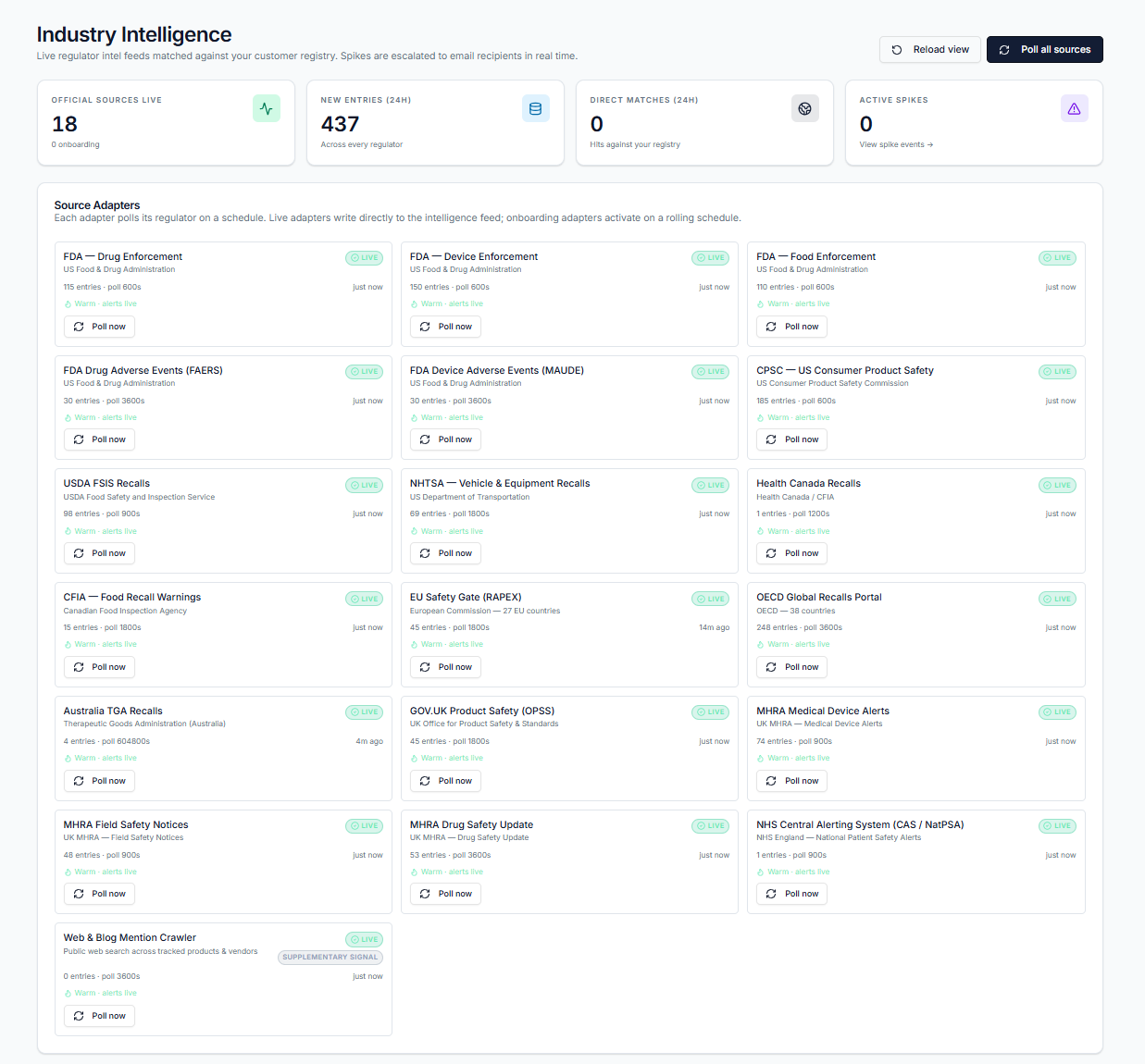
- Monitoring of NHTSA ODI preliminary evaluation and engineering analysis openings that involve your component suppliers — a supplier's recall often predicts that downstream manufacturers using the same component will receive inquiry letters
- RAPEX / EU Safety Gate monitoring for safety notifications involving your vehicle models in European markets, which frequently precede or trigger parallel NHTSA actions
The internal signal aggregation layer:
- Automated warranty claim threshold monitoring against EWR reporting thresholds, with alerts when trending suggests threshold crossing before quarter-end
- Real-time consumer complaint categorization and clustering, with escalation triggers when complaint density in a component system exceeds internal thresholds
- Field technical service bulletin review for patterns that indicate a systematic defect mode not yet reflected in warranty or complaint data
The decision-support layer:
- Documented Section 15(b)-equivalent analysis for automotive: a structured review process that applies the NHTSA defect determination standard to aggregated signal data, with documented decisions and timelines
- Part 573 pre-population: when a preliminary determination is made, the Part 573 report fields should auto-populate from the signal record — so the 5-business-day filing can occur from an organized record rather than a scramble
Transport Canada and International Recall Coordination
A vehicle safety defect recognized in the United States almost always has parallel implications for Canadian and international markets. Transport Canada's Motor Vehicle Safety Act requires manufacturers to notify Transport Canada within 5 days of making a safety defect or noncompliance determination — the same timeline as NHTSA, meaning that the Part 573 filing and the Transport Canada notification should occur simultaneously.
Transport Canada specific requirements:
- Bilingual (English and French) owner notification letters for vehicles sold in Canada
- Canadian VIN population scope definition, which requires separate production records analysis for vehicles assembled or distributed for the Canadian market
- Transport Canada recall status updates and completion rate reporting on a separate schedule from NHTSA
For European market vehicles, EU type approval authorities and national competent authorities must be notified through the RAPEX (EU Safety Gate) system. This notification is separate from NHTSA and Transport Canada notifications and has its own content requirements and timelines.
The parallel jurisdiction operational model: The most effective approach is to treat NHTSA, Transport Canada, and relevant EU authorities as simultaneous notification targets — not sequential ones. A defect determination triggers parallel regulatory notification workflows, with jurisdiction-specific content populated from a single defect record. The alternative — notifying NHTSA first, then working through Transport Canada and EU notifications sequentially — is slower, creates inconsistency risk in the regulatory record, and risks missing international deadlines.
What Good Automotive Recall Readiness Looks Like
An automotive OEM or Tier 1 supplier with a mature recall readiness program in 2026 demonstrates several capabilities that regulators and internal auditors look for:
Documented defect monitoring policy: A written procedure that defines which data sources are monitored, at what frequency, using what thresholds, and who is responsible for conducting the Section 573-equivalent analysis when thresholds are crossed. The procedure is tested, not just documented — quarterly exercises demonstrate that the team can produce a Part 573 filing within 5 business days from a simulated defect signal.
VIN-level production data integration: A working integration between the vehicle master data system and the recall management platform that can produce a VIN list for a given component lot, date range, and model configuration within hours rather than days.
EWR automation: Quarterly EWR submissions that are generated semi-automatically from integrated warranty, complaint, and field report data — with the manual effort limited to review and sign-off rather than data aggregation.
Multi-jurisdiction parallel notification capability: Pre-configured workflows for NHTSA, Transport Canada, and EU type approval notifications that can be triggered from a single defect record, with jurisdiction-specific content templates maintained and tested.
Documented and organized investigation records: An audit trail that can demonstrate to NHTSA or Transport Canada investigators exactly when each piece of information was received, how it was analyzed, what conclusions were drawn, and when the determination was made — the evidence base that determines whether a company is found to have complied with its 5-day reporting obligation or violated it.
SuperRecall.ai helps automotive OEMs and Tier 1 suppliers build NHTSA-ready recall management programs — including automated NHTSA ODI complaints database monitoring, TREAD Act EWR data aggregation, VIN-level recall scope definition, and multi-jurisdiction notification workflows for NHTSA, Transport Canada, and EU type approval authorities. To see how our platform supports your vehicle safety compliance program, request a demonstration.
Ready to Protect Your Brand?
SuperRecall.ai helps global brands stay ahead of product recalls with AI-powered monitoring and workflow automation. Monitor 44+ regulatory databases including FDA, CPSC, EU Safety Gate, and CFIA — automatically, around the clock.