Best Practices

    The Recall Communications Playbook: Writing Consumer Notifications That Hold Up Under Scrutiny

    How to write the consumer-facing notification that protects public health, satisfies regulators, withstands later review, and does not create avoidable damage to the brand

    12 min read

    The Recall Communications Playbook: Writing Consumer Notifications That Hold Up Under Scrutiny

    How to write the consumer-facing notification that protects public health, satisfies regulators, withstands later review, and does not create avoidable damage to the brand.

    Why the Notification Matters Out of All Proportion

    The consumer-facing notification is, in most recalls, a small fraction of the total operational work. Hundreds of person-hours go into investigation, classification, scope determination, traceability reconstruction, retrieval logistics, and regulator engagement. Some fraction of one person's day goes into writing the public notification.

    That is roughly the right ratio for the operational difficulty. It is not the right ratio for the long-term consequences. The consumer notification is the most public artefact the recall produces. It is read by customers, journalists, regulators, plaintiffs' counsel, and competitors. It sits on the regulator's website for years. It becomes the de facto public record of the event, often consulted long after the recall itself has closed.

    A well-written notification does not, on its own, prevent reputational damage from a recall. But a poorly-written notification can create damage that the underlying recall did not require — by being unclear about the hazard, by being inconsistent with messages used in other markets, by sounding evasive in tone, or by missing the practical information that determines whether consumers can actually act on it.

    This article is a structured playbook for the writing itself: the components a notification must include, the tone discipline that holds up over time, the consistency requirements across markets, and the review process that prevents avoidable mistakes.

    What the Notification Must Do

    Before turning to the writing, it is worth being explicit about what the notification is for. A consumer notification has four functions, in order of priority:

    1. Enable consumers to identify whether they have the affected product. Without this, none of the other functions matters.
    2. Communicate the specific hazard clearly enough for consumers to understand the risk. This includes both the nature of the hazard and the actions consumers should take to avoid it.
    3. Provide actionable instructions for what consumers should do. Stop using, return for refund, contact the company, seek medical attention if symptoms occur — whatever the specific situation requires.
    4. Establish a record of the company's communication that will be reviewed later by regulators, the public, and (in litigation cases) opposing counsel.

    The four functions are not in tension, but the writing discipline differs across them. The first function rewards specificity. The second rewards clarity. The third rewards plain action language. The fourth rewards measured, honest, and consistent tone. A notification that excels at one function and fails at another is a poor notification.

    The Required Components

    A complete consumer notification has a small set of components. Each should be present in every notification; missing any of them is, in most cases, a defect.

    Component 1: Product Identification

    The product identification section enables consumers to determine whether they have the affected product. It should include:

    • Product name — the specific commercial name as it appears on the product, not an internal SKU description.
    • Variant or specification — the specific size, flavour, formulation, or model affected, with the specific identifiers consumers can use to confirm the match.
    • Lot or batch identifiers — the specific lots, batches, serial numbers, or date codes affected, with clear instructions on where to find them on the product or packaging.
    • Date of distribution — the dates during which the affected product was sold, to help consumers reason about whether they may have purchased it.
    • Channel of distribution — the retailers, channels, or geographies where the product was sold.
    • Photographs or images — where space and format allow, photographs that visually identify the affected product, including the location of the lot identifier on the packaging.

    The discipline is to imagine the consumer reading the notification in a kitchen, holding the product in one hand, and trying to determine whether it matches. The product identification section should make that determination unambiguous.

    Component 2: Hazard Description

    The hazard description communicates the specific risk the product presents. It should:

    • State the hazard plainly. "Contains undeclared peanuts," "may overheat during use," "potential bacterial contamination."
    • Describe the consequences. What can happen if a consumer is exposed to the hazard? Allergic reaction, burn injury, illness — be specific without being either alarmist or minimising.
    • Identify the at-risk population, if applicable. Some hazards present specific risk to particular populations — children, immunocompromised individuals, people with specific allergies. Where applicable, identify them.
    • State whether incidents have been reported, with care. If incidents have been reported, the notification should say so clearly. If incidents have not been reported, the notification should say "no incidents have been reported" only if that is true at the moment of issuance — a statement that is true at issuance and false a week later creates exactly the credibility problem the notification is trying to avoid.

    A common drafting mistake is to soften the hazard description in a way that obscures the risk. The legal and reputational instinct to minimise is understandable, but the resulting language ("a quality issue," "out of an abundance of caution") rarely satisfies the regulator's expectations and rarely sounds credible to consumers. A clear, plain description of the actual hazard is both safer for the public and stronger for the company.

    Component 3: Action Instructions

    The action instructions tell consumers what to do. They should be specific and operationally complete:

    • The primary action — stop using, return for refund, dispose of, seek medical attention, contact the company.
    • The mechanics — where to return the product, how to obtain a refund, what to bring, what to expect.
    • The contact information — a dedicated channel (phone, email, web form) for questions and follow-up. The contact should be staffed and operationally functional from the moment the notification is issued.

    Instructions that send consumers to a generic customer service channel that is not prepared for recall volume will, predictably, produce poor consumer experience and a secondary stream of negative attention. The action instructions section is also a commitment to staffing and operational readiness.

    Component 4: Company Statement

    A brief company statement provides context and conveys the company's posture. It should:

    • Acknowledge the company's accountability — without being either evasive or melodramatic.
    • Confirm the actions the company is taking — corrective actions in the supply chain, regulator cooperation, follow-up communications.
    • Express genuine care for affected consumers — without overdoing it. A single sentence is usually right.

    The discipline is restraint. A company statement that takes more space than the product identification, hazard description, and action instructions combined usually reads as defensive rather than substantive.

    The Tone Discipline

    The single most consequential decision in writing a consumer notification is the tone register the writer adopts. The right register has four properties.

    It is plain.

    The notification is read by people who are not specialists in the company's category, the regulatory framework, or the technical nature of the hazard. Plain language — short sentences, common words, concrete nouns — is the default. Technical or regulatory language is used only where necessary and is glossed when it is.

    It is measured.

    The notification is not the place to apologise extravagantly, to invoke the company's commitment to quality, or to defend the company's broader record. A measured register — straightforward statement of what happened, what consumers should do, and what the company is doing — communicates accountability more effectively than expressive language.

    It is consistent across audiences.

    The consumer notification, the trade-partner notification, the regulator submission, and the press statement should all be consistent in the substance they describe and the tone in which they describe it. A consumer notification that uses softer language than the regulator submission is, in the current information environment, a near-certain credibility problem.

    It does not predict the future.

    A notification should describe what is currently known and what consumers should currently do. It should not predict that "no further action will be required" or that "the issue is fully resolved" — predictions that may turn out to be false produce material credibility damage. If further action becomes necessary, the company will need to issue a follow-up notification; pre-committing to "no further action" makes that follow-up much harder to write credibly.

    Cross-Market Consistency

    For multinational recalls, cross-market consistency is one of the most operationally consequential disciplines. Three rules.

    Rule 1: One Substance, Many Adaptations

    The substantive description of the hazard, the affected products, and the recommended consumer actions should be consistent across markets. The adaptations across markets are appropriate where they reflect genuine differences — language, regulatory framework, distribution channel, retailer relationships — but should not soften or strengthen the substance in any market.

    Rule 2: Comparative Claims Must Be True Everywhere

    Any comparative claim ("affects only X% of units," "no injuries reported," "limited to a single production line") must be either true in every market the message reaches, or scoped explicitly to the market it applies to. Otherwise it should not be in the message, in any market.

    Rule 3: Translation Is a Substantive Activity

    For markets where the notification will be translated, translation is a substantive activity that requires review by someone who is both fluent in the target language and familiar with the substance of the recall. A translation that is technically accurate but loses tone control is itself a credibility problem. Translations should be reviewed, ideally by someone with experience in regulator-facing communication in the target market.

    The Review Process

    A consumer notification that performs all of the above should pass through a structured review process before issuance. The review involves:

    • The recall response leader — confirms substantive accuracy and consistency with the regulator submissions.
    • A regulatory affairs lead with category and jurisdiction expertise — confirms compliance with the formal requirements of each regulator the notification reaches.
    • Legal counsel — reviews for liability and discovery implications, with the discipline of identifying language that is more dangerous than the underlying facts require.
    • A communications lead — reviews for tone, clarity, and consistency with broader company communication.
    • At least one reader who is not part of the recall response team — reads the notification cold, as a consumer would, and reports what is unclear or what raises questions the notification does not answer.

    The cold-read reviewer is the one most often skipped. It should not be. The reviewer who has not been working on the recall for weeks reads the notification with the eyes of the actual audience and routinely surfaces the unclarities that everyone closer to the work has stopped seeing.

    A Notification Template

    For working purposes, a notification structure that consistently delivers:

    1. Headline statement — one sentence identifying the company, the product, and the hazard.
    2. Affected product — full identification with photographs, lot codes, date codes, distribution dates, and channels.
    3. Hazard and consequence — plain description of the hazard, the consequence, and the at-risk population.
    4. Incident status — whether incidents have been reported, with appropriate caveats.
    5. Consumer action — the specific action consumers should take, with operational mechanics.
    6. Contact information — the dedicated channel for questions and follow-up.
    7. Company statement — a short paragraph acknowledging accountability and confirming corrective action.
    8. Regulator citation — appropriate citation of the regulator and the recall classification, where applicable.

    The structure is conventional, which is the point. Consumers, regulators, journalists, and other readers know what they expect to see in a recall notification, and a structure that meets the expectation lets them focus on the substance rather than the form.

    How Software Helps

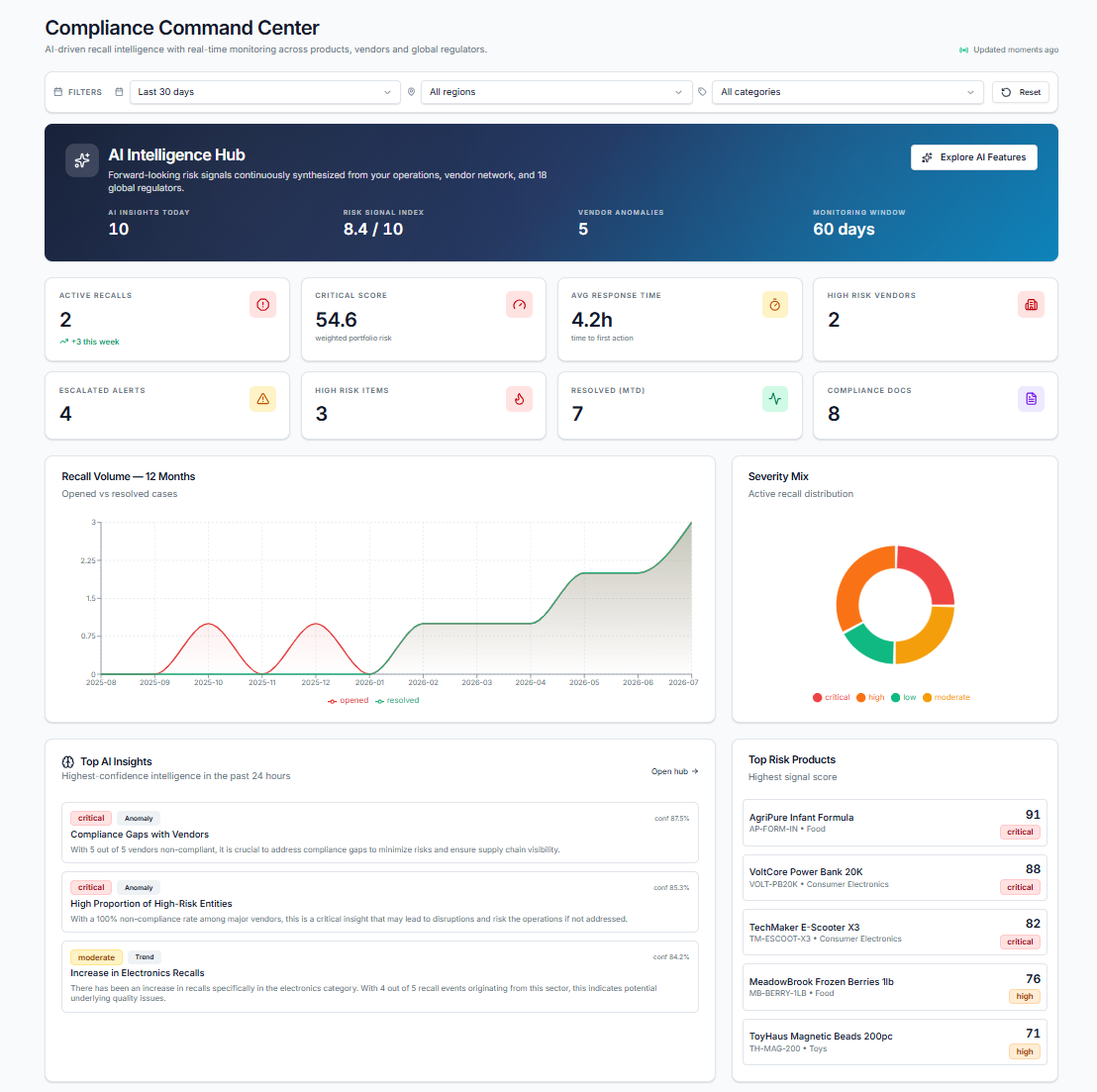
    A recall management platform's role in the communications workstream is specific. It does not write the notification. What it provides is the structured workflow that holds the notification drafting, review, approval, and distribution as part of the broader recall record, and the audit trail that documents what was issued, when, by whom, and to which channels.

    For multinational recalls, the platform also provides the consistency surface — a single view of the notifications issued across markets that supports cross-market consistency review and cross-functional accountability.

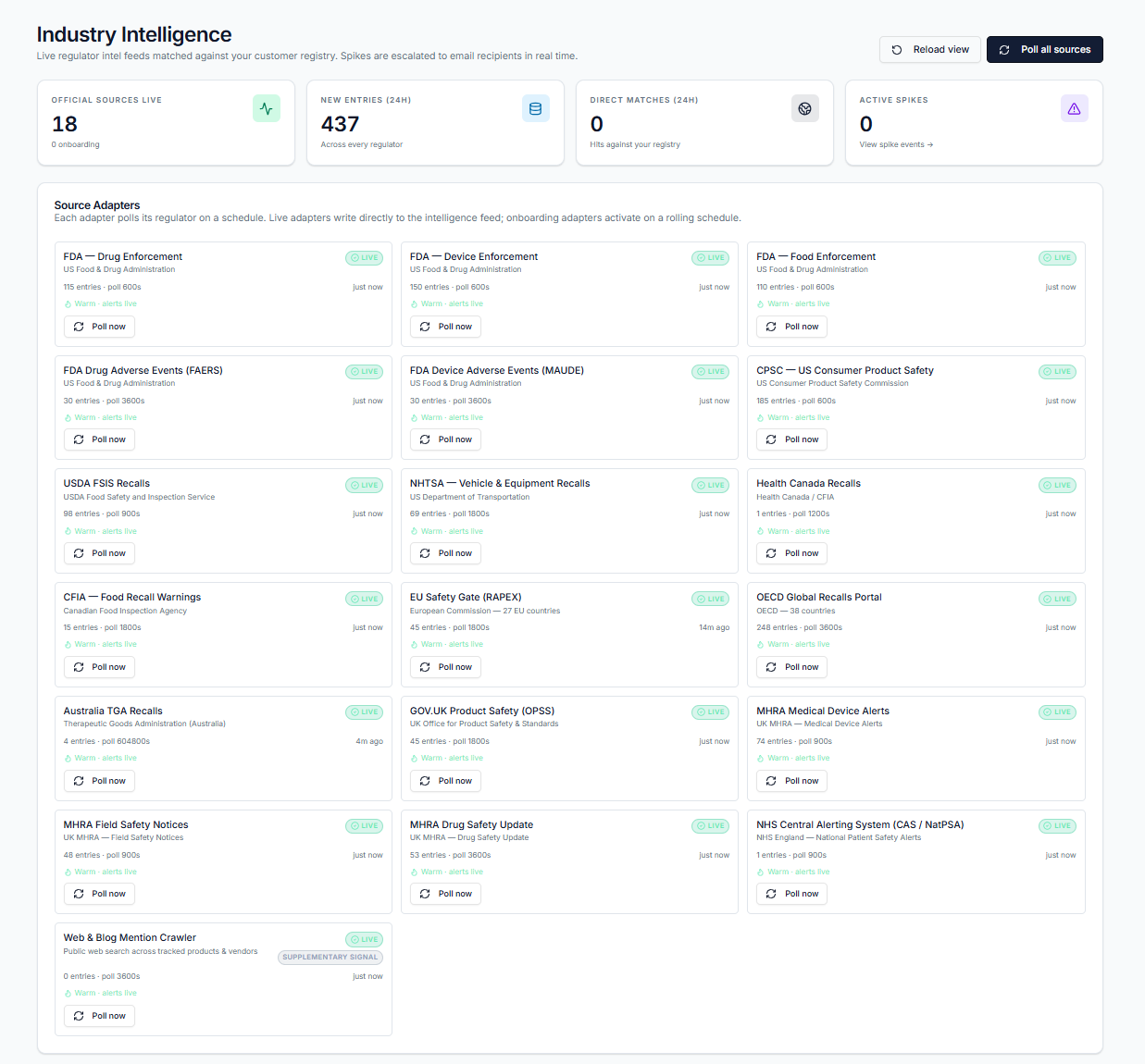
    SuperRecall.ai is designed to operate in this role, with workflow templates that accommodate notification drafting and review, role-based access control for cross-functional review participation, and a tamper-evident audit log that records the full notification lifecycle. The platform also monitors 44+ regulatory databases — including FDA, CPSC, USDA-FSIS, Health Canada, CFIA, EU Safety Gate, and the major member-state surveillance authority feeds — so that the communications workstream is anchored to the same external signal picture the rest of the recall response relies on. SuperRecall.ai's SOC 2 posture is currently Audit In Progress, and we are happy to discuss the current state with security and procurement teams that need to verify the picture.

    Closing Note

    The consumer notification is a small share of the recall's operational work and a large share of its long-term public footprint. The writing discipline is straightforward — plain, measured, consistent, complete — but it requires the kind of structured review and cross-market coordination that recall response teams under pressure often skip. Building the discipline before pressure is on is what makes the discipline reliable when it is.

    If your team would like to discuss how SuperRecall.ai supports the notification workflow within the broader recall management process, book a working session or contact sales@superrecall.ai. Our respond to a recall in 24 hours guide and the recall response team guide are useful companion reading.

    Share this article
    Take Action Now

    Ready to Protect Your Brand?

    SuperRecall.ai helps global brands stay ahead of product recalls with AI-powered monitoring and workflow automation. Monitor 44+ regulatory databases including FDA, CPSC, EU Safety Gate, and CFIA — automatically, around the clock.

    We use cookies to improve your experience

    Strictly necessary cookies keep the site running. With your consent we also use Google Analytics 4 to understand how visitors use SuperRecall.ai. You can change your choice at any time. See our Cookie Policy for details.