CFIA and Health Canada Recall Operations in 2026: An Operating Guide for Canadian Food Manufacturers
How to structure incident intake, classification, notification, and post-recall reporting under the Safe Food for Canadians framework — and where Canadian operations differ meaningfully from FDA practice
CFIA and Health Canada Recall Operations in 2026: An Operating Guide for Canadian Food Manufacturers
How to structure incident intake, classification, notification, and post-recall reporting under the Safe Food for Canadians framework — and where Canadian operations differ meaningfully from FDA practice.
Why a Canada-Specific Operating Guide Is Worth Writing
For multinational food businesses operating across both the United States and Canada, it is tempting to treat recall obligations as a single transcontinental compliance picture with minor jurisdictional variations layered on top. In broad strokes, the FDA, CFIA, and Health Canada frameworks share the same intent: protect public health, remove unsafe products from the market quickly, and create an audit trail that can withstand later review.
In practice, the operational details differ enough that a US-centric playbook applied to Canadian operations will routinely produce missed notification windows, incomplete public communication, and friction with the inspectorate. Canadian food manufacturers — and the Canadian arms of multinational brands — benefit from an operating model that is built around the Safe Food for Canadians Act (SFCA) and the Safe Food for Canadians Regulations (SFCR) as the primary frame, with FDA practice treated as a separate regime rather than a default.
This article walks through the operating model end to end, with a focus on the differences from US practice that matter the most under pressure.
The Regulatory Stack: SFCA, SFCR, and the FDA (the Other FDA)
The primary statute governing food recalls in Canada is the Safe Food for Canadians Act, supported by the Safe Food for Canadians Regulations. The Canadian Food Inspection Agency (CFIA) is the primary inspectorate. The federal Food and Drugs Act — confusingly sharing initials with the US agency — and its associated regulations layer additional requirements, particularly around food safety, labelling, and natural health products.
Health Canada's role in food is principally policy, standard-setting, and risk assessment. The CFIA owns enforcement and recall coordination. Manufacturers, importers, and distributors of food sold in Canada are required to hold a Safe Food for Canadians Licence (with limited exemptions), to implement a written Preventive Control Plan (PCP), and to maintain traceability records that allow movement of food to be tracked one step back and one step forward.
The licensing, PCP, and traceability requirements are not just baseline obligations. They are the operational substrate on which a credible recall response is built. A Canadian recall executed by a manufacturer with a weak PCP and patchy traceability records is, in the inspectorate's eyes, a much more concerning event than one executed by a manufacturer with mature foundations.
The CFIA Recall Classification Scheme
CFIA classifies food recalls into three classes by health risk:
- Class I — Reasonable probability that consumption will lead to serious adverse health consequences or death.
- Class II — Consumption may cause temporary or non-life-threatening health consequences, with a remote probability of serious effects.
- Class III — Consumption is not likely to cause adverse health consequences but the product violates regulatory requirements (for example, mislabelling without an allergen risk).
The class triggered determines how the recall is communicated, how the inspectorate engages, and what post-recall verification activity follows. Class I recalls are accompanied by a Public Warning issued via the CFIA website, the Government of Canada email subscription system, and increasingly through social and trade channels. Class II recalls may or may not involve a Public Warning depending on the distribution profile and the practical ability of consumers to identify the product. Class III recalls typically do not involve a Public Warning.
For comparison: while the FDA's three-class system is structurally similar in name, the operational consequences attached to each class — particularly around mandatory public communication and inspectorate engagement — are not identical. Multinational teams should not assume that an FDA Class II recall will automatically be a CFIA Class II recall, or that the public communication footprint will be the same.
Incident Intake: Building a Defensible Trigger Process
The first operational test in any recall is whether the company's incident intake produces a clear decision point at a clear moment. CFIA expects manufacturers to have a documented process — typically embedded in the PCP — for receiving, evaluating, and acting on:
- Consumer complaints, including those received via retailer customer service or social media monitoring.
- Internal quality findings, including out-of-specification results from finished-product, environmental, or in-process testing.
- Supplier notifications, including upstream raw-material recalls and supplier corrective action notices.
- Regulator alerts and inquiries, including CFIA recall notices on similar products and Public Warnings affecting categories or ingredients used by the company.
- Trade-partner notifications, including distributor and retailer reports of suspected non-conformance.
Each of these intake channels needs an owner, a service-level commitment, and a documented escalation path. The defensibility test is straightforward: when CFIA reviews the incident timeline after a recall, can the company show — with timestamps and named individuals — when the signal arrived, who triaged it, what they decided, and on what basis?
For multinational operations, an additional question matters: does the Canadian intake process produce its own decision point, or is it dependent on a global incident review that may run on different time zones and different escalation conventions? A Canadian-specific intake function with authority to escalate locally — and to interlock with global decision-making rather than wait for it — is operationally important.
Notification Windows and the CFIA Engagement Pattern
Once the manufacturer has determined that a recall is required, the immediate operational question is the notification timeline. Under SFCR, manufacturers, importers, and distributors are required to notify CFIA without unjustifiable delay once they know or have reason to suspect that a food they have manufactured, imported, or sold is or was unsafe.
In practice, "without unjustifiable delay" has been operationalised by the inspectorate to mean that, once the internal decision to recall is taken, CFIA expects to be notified the same business day, with a follow-on submission of the supporting recall information package within a short window thereafter. Multinational teams accustomed to FDA's category-specific timelines (for example, the 24-hour standard for the Reportable Food Registry) will find the Canadian standard recognisable in spirit but distinct in its emphasis on early engagement with the inspectorate as a coordinating partner rather than a regulator notified only at formal milestones.
The CFIA recall information package typically includes product identification, the nature of the hazard or non-conformance, distribution information, the proposed recall classification, the proposed recall communication strategy, and the proposed disposition of recovered product. The inspectorate may agree with the proposed classification or assign a different one based on its own assessment.
A practical pattern for the strongest Canadian operations: an early, informational call to the local CFIA office at the moment a Class I or Class II recall becomes likely, followed by submission of the formal package once internal review is complete. This pattern is not required, but it is consistent with the inspectorate's stated preference for early engagement and tends to reduce friction in the formal review.
Public Communication: The Public Warning and Its Implications
For Class I recalls — and for many Class II recalls where the product profile makes consumer identification difficult — the CFIA Public Warning is the dominant communication mechanism. The Public Warning is issued by CFIA itself, with content developed in collaboration with the recalling firm. Once issued, it is published on the CFIA website, distributed via the Government of Canada subscription email system (the "Healthy Canadians" channel for food recalls), and increasingly amplified through social media.
For multinational brands, the operational significance of the Public Warning is that the recalling firm does not control the timing or content of the primary public communication channel in the way it might in some other jurisdictions. The communication is a joint product, but the inspectorate is the publisher. This shapes the work the firm should do in advance:
- Pre-prepared consumer notification copy, validated against the company's evidence package and aligned with the messaging used in other jurisdictions.
- Pre-prepared retailer and distributor notification templates, with a clear distribution list and a documented process for confirming receipt.
- A bilingual (English and French) communication capability, which is a Canadian-market necessity, not an optional extra.
Bilingual capability is not just a legal requirement under various federal and provincial frameworks — it is an operational reality of the Canadian retail and consumer environment. A consumer notification that is well-written in English and weak in French will be perceived as such, and that perception itself becomes part of the recall's reputational footprint.
Trading-Partner Notification and Trace-Back/Trace-Forward
The Canadian framework places strong emphasis on the manufacturer's ability to demonstrate the full distribution chain of recalled product — both upstream (where the affected raw materials came from) and downstream (where the affected finished product went). The "one step back, one step forward" traceability standard is a minimum, not a target, and the inspectorate increasingly expects that mature operations can reconstruct multi-step distribution paths inside the recall response window.
Operationally, this means:
- Sales and shipment records for the affected lot codes need to be available in a format that can be filtered, exported, and shared with CFIA in hours, not days.
- Trading-partner notifications need to be issued through documented channels with confirmation of receipt — a recall notice sent by general-purpose email and never followed up is, from the inspectorate's perspective, an incomplete notification.
- Distributor and retailer compliance with stop-sell, hold, and return instructions needs to be tracked and reported as part of the recall closure documentation.
Companies that have invested in a recall management platform with structured trading-partner notification, signed acknowledgement, and compliance tracking find this part of the workflow materially easier than companies relying on manual email chains and ad-hoc spreadsheets.
Post-Recall: The Effectiveness Check and File Closure
A Canadian recall does not end when the Public Warning is published. The recalling firm is expected to conduct an effectiveness check — a structured verification that the recall has actually achieved its objective, typically measured against agreed criteria for the percentage of distributed product accounted for, the proportion of trading partners that have confirmed compliance, and the absence of further consumer reports following the warning.
The effectiveness check is documented and submitted to CFIA, along with a post-recall report that addresses the root cause investigation, the corrective and preventive actions implemented, and the firm's assessment of the recall's effectiveness. CFIA's review of these submissions is part of the basis on which the recall file is closed and on which the firm's broader compliance posture is judged at the next inspection.
The post-recall report is, in many respects, the most important document the firm produces during the recall lifecycle. It is the record that will be reviewed at the next inspection, that may be cited in future enforcement decisions, and that — in serious cases — may become part of the public record. The discipline of writing a complete, candid, and well-evidenced post-recall report pays back across years.
Where Software Helps
Recall management software is not a substitute for a strong PCP, traceability programme, or trained recall response team. What it adds, when chosen and operated well, is a structured layer above the operating systems of record — the ERP, WMS, lab system, and quality management platform — that holds the workflow, the evidence, and the audit trail of the recall itself in one place.
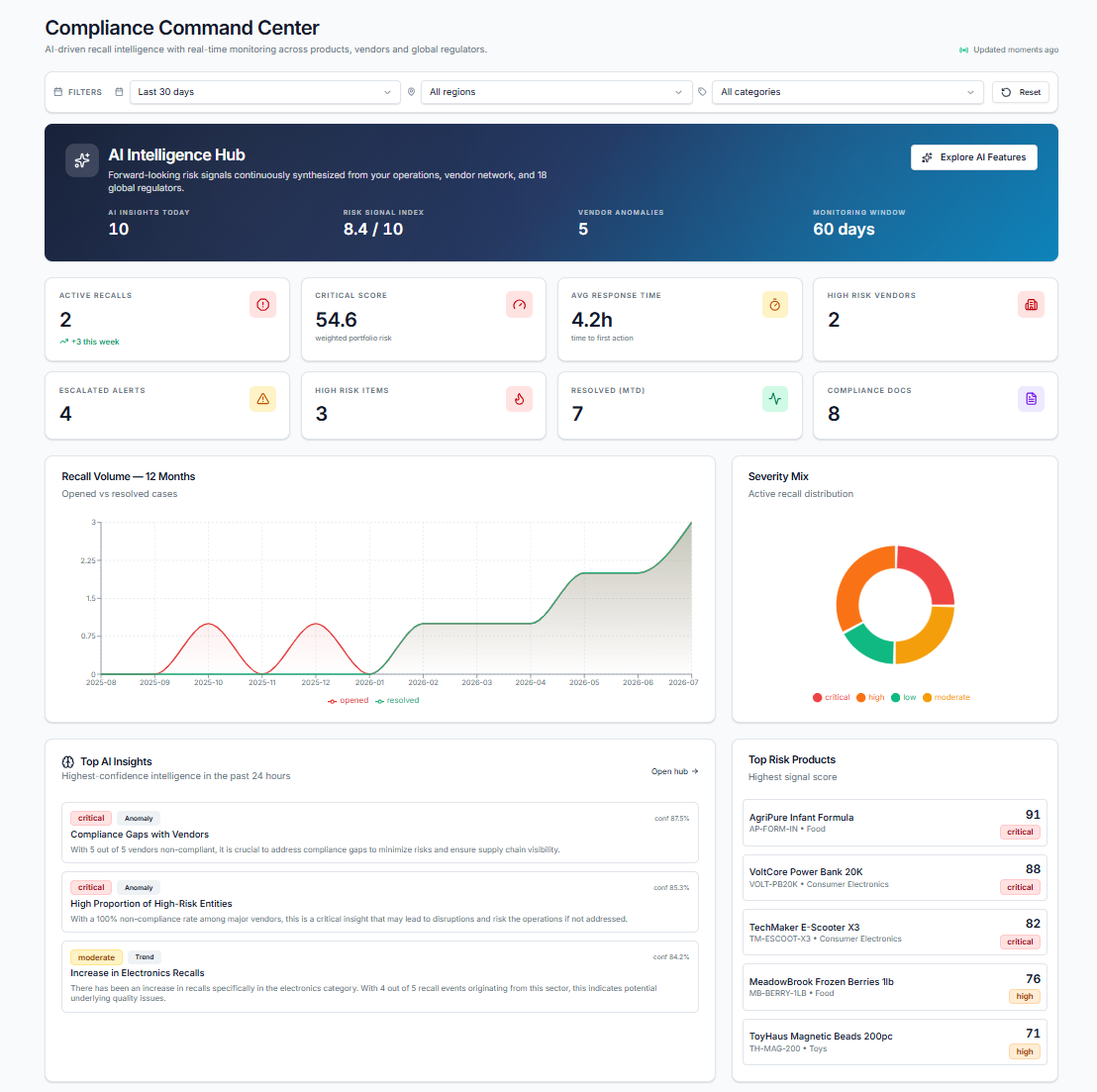
For Canadian operations specifically, the platform capabilities that matter are: monitoring of CFIA recall and Public Warning feeds, integration with the bilingual communication requirements that any Canadian-market notification must respect, structured trading-partner notification with acknowledgement tracking, and an audit log that meets the documentation expectations of the inspectorate.
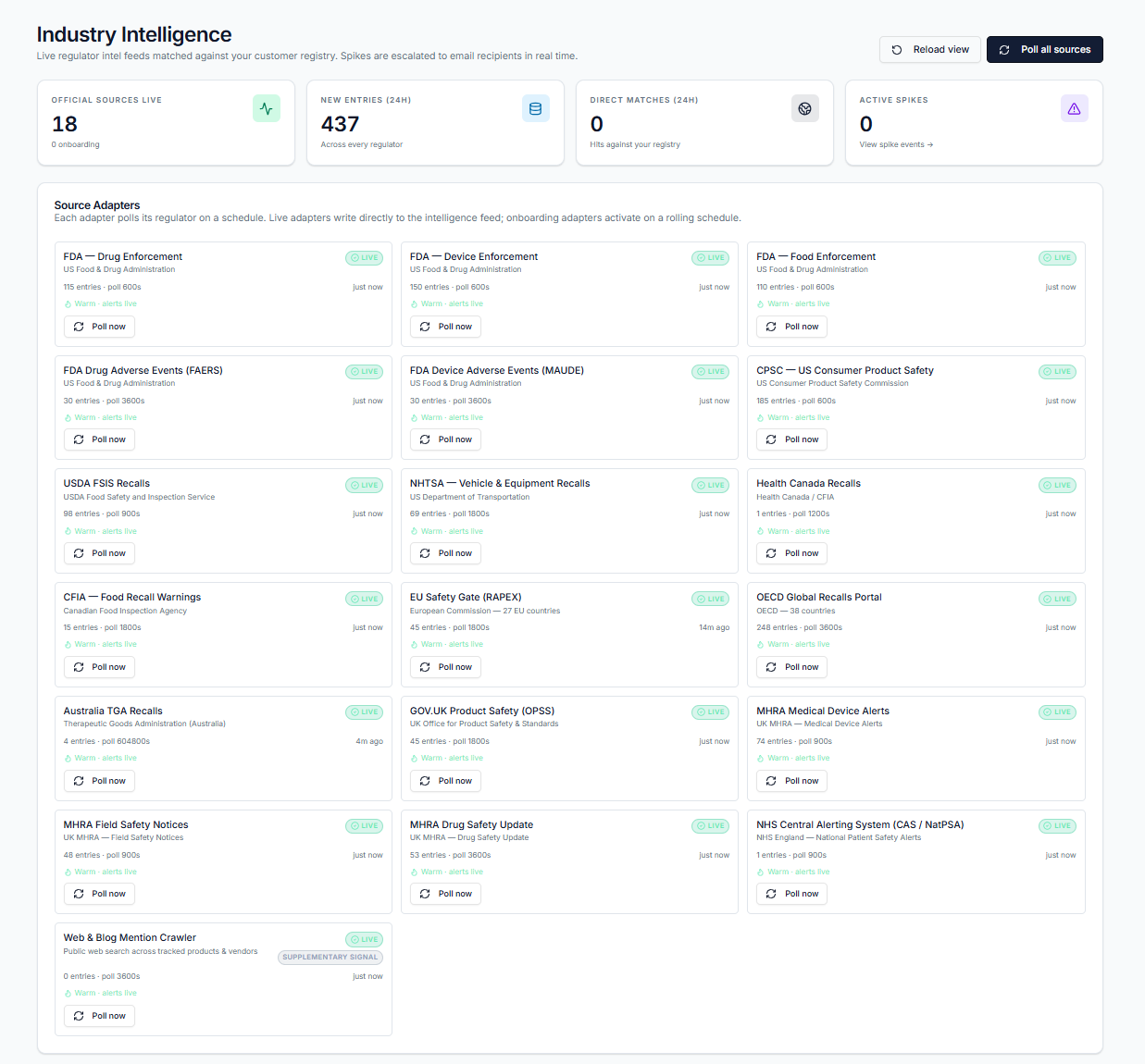
SuperRecall.ai monitors 44+ regulatory databases including CFIA recall and inspection feeds, Health Canada recall and advisory feeds, the Public Health Agency of Canada outbreak alert system, and the corresponding feeds from the FDA, USDA-FSIS, and other major markets. The audit log is tamper-evident and role-based, the notification workflow supports bilingual content alongside the original-language record, and the platform is designed to interoperate with the operational systems of record where the underlying traceability data lives. SuperRecall.ai's SOC 2 posture is currently Audit In Progress, and we are happy to discuss the current state with security and procurement teams that need to verify the picture.
Closing Note
The Canadian recall framework rewards manufacturers who treat the inspectorate as a partner in protecting public health rather than an adversary to be informed at the latest possible moment. Companies that operate with that posture, supported by mature foundations and a structured recall workflow, will find that the most stressful events still feel under control. Companies that do not will, sooner or later, find themselves in the public part of an operating story they would have preferred to keep private.
If your Canadian or multinational team would like to walk through your recall readiness against the CFIA and Health Canada frameworks, book a working session with our team or write to sales@superrecall.ai. We will work through a realistic scenario with your category, your distribution footprint, and your existing tooling as the starting point. For broader context on how Canadian practice fits the global picture, our global recall regulations comparison and the multi-jurisdiction recall coordination playbook are good companions to this piece.
More from SuperRecall.ai
FDA FSMA Recall Readiness in 2026: What Food Manufacturers Must Have in Place
CFIA Food Recall Process: A Step-by-Step Compliance Guide for Canadian Manufacturers
FSMA 204 Final Countdown: Where Food Manufacturers Stand 90 Days from the Compliance Deadline
Ready to Protect Your Brand?
SuperRecall.ai helps global brands stay ahead of product recalls with AI-powered monitoring and workflow automation. Monitor 44+ regulatory databases including FDA, CPSC, EU Safety Gate, and CFIA — automatically, around the clock.